
Quick Answer: Can a rusted or broken boat trailer frame be repaired? In most cases, yes. Rotted rear sections, cracked crossmembers, broken rails, and rusted tongues can all be rebuilt by a qualified welding and fabrication shop, as long as the main frame underneath is still sound. The repair-or-replace call comes down to how much of the trailer is actually salvageable, what the rebuild will cost against the price of a new trailer, and whether the steel you’re keeping is going to hold up. Frame repair at our Flint, MI shop starts as low as a couple hundred dollars for small patch work, and goes up from there for full rear-section rebuilds.
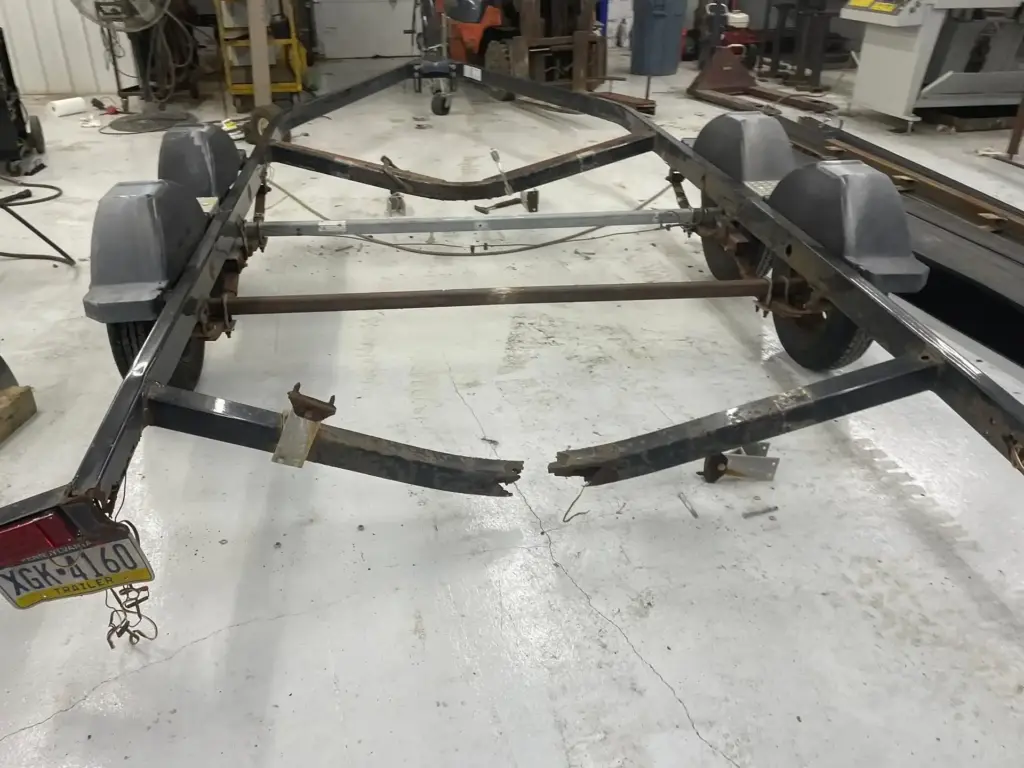
Last fall, a guy pulled up to our Flint shop with a boat trailer that had no business being on the road. He was selling the boat, and the buyer wasn’t going to close until the trailer was road-legal. What he brought us was rougher than he realized when he unloaded the boat to come over.
The rear frame rails were rusted out and broken clean off. The crossmember under the transom was cracked through. Bunk wood was rotten to the point of being soft when you pressed on it. Tail lights were dangling by frayed wiring, and an old license plate wired on with a piece of baling wire was doing most of the work of holding the rear together.
On paper, a trailer most shops would have refused to touch. The easy answer is to tell the customer they’re better off buying new. Less risk for the shop, quicker job, and sometimes it’s the honest answer. Not always, though.
When we got underneath it, the front half of the frame told a different story. The tongue was straight. Main rails from the axles forward were solid. Axles, springs, hubs, all serviceable. The damage was concentrated in the back third of the trailer. Which meant the bad steel could come out, and the good steel could stay.
So we rebuilt it. 😀
Here’s what that actually involved, and how I decide when a trailer is worth saving versus when I’d rather give somebody the bad news and lose the job.
What Was Wrong With This Trailer
Before we quote a repair-or-replace on anything, I walk the whole trailer with the customer. Every section. You can’t make an honest call on a rebuild without a complete picture, and that’s true whether you’re looking at a boat trailer, a landscape trailer, or a 24-foot equipment hauler. Skip the inspection and you end up halfway into a job finding damage you should have priced in at the start.
Here’s what we were working with.
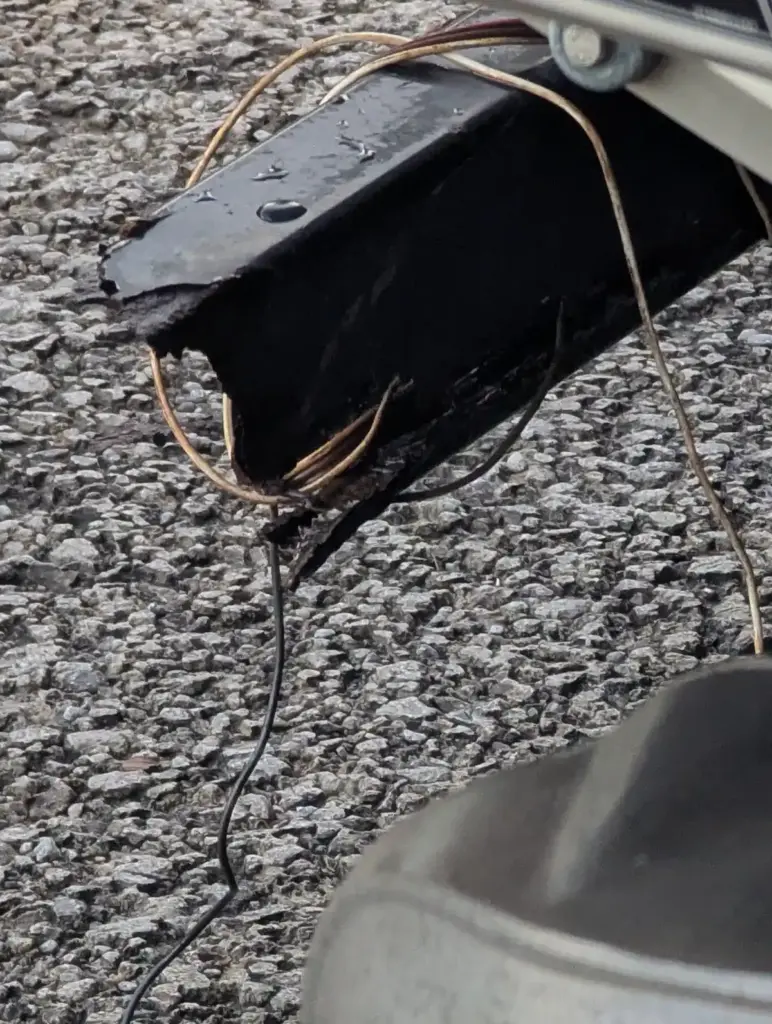
The rear frame ends. These are the sections of rail that stick out behind the boat, where the tail lights mount. They were gone. Not worn, not weak, gone. Water gets inside a hollow tube, can’t get out, and eats the steel from the inside. By the time you can see it from outside, the wall thickness is already half of what it started as. There’s no patching that. Has to come out.
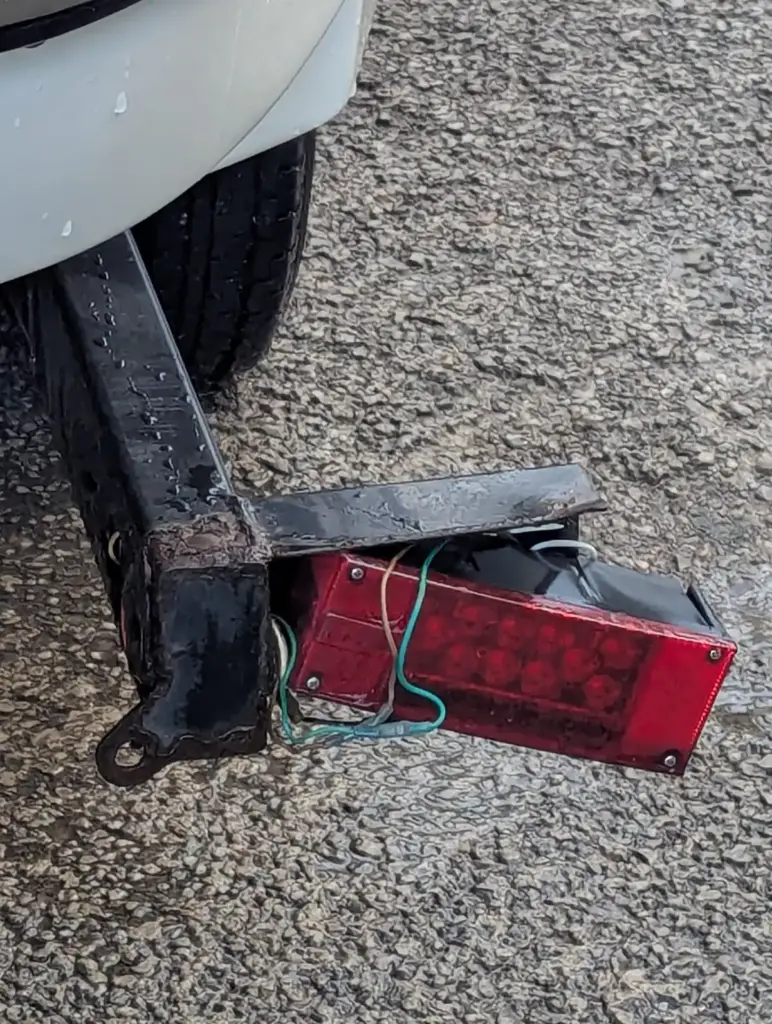
Lights and wiring. Both tail lights were dangling off the back by nothing but wire. Cracked housings, no working ground, splices wrapped in regular electrical tape instead of marine-rated connectors. Fails a Michigan roadworthy check on the lights alone, before you even get to the frame. Michigan law (MCL 257.686) requires a trailer to have at least one working rear lamp visible from 500 feet, plus a working license plate light.
Center crossmember. The crossmember that runs under the transom is where most of the boat’s weight lands when you hit a bump. That one was cracked straight through on one side. Classic failure. It’s the highest-stress point on most boat trailers, so that’s where cracks tend to show up first.
Bunks. The 2×6 bunk boards were soft. Press a thumb in and it gave. Soft bunks let the boat shift around in transit, and every bit of that movement travels back into the frame. Which is part of why the frame was in the shape it was in.
Wiring. Corroded the full length of the trailer. Spliced in six places, no clean ground on the frame anywhere. Whoever worked on this last wasn’t a trailer guy.
What we didn’t find: A bent tongue, twisted main rails, or worn-out axles. The spine of the trailer was solid. That was the line between repair and scrap on this one.
How We Repaired It
The back third of the trailer came off. Bare metal, nothing left of the rot.
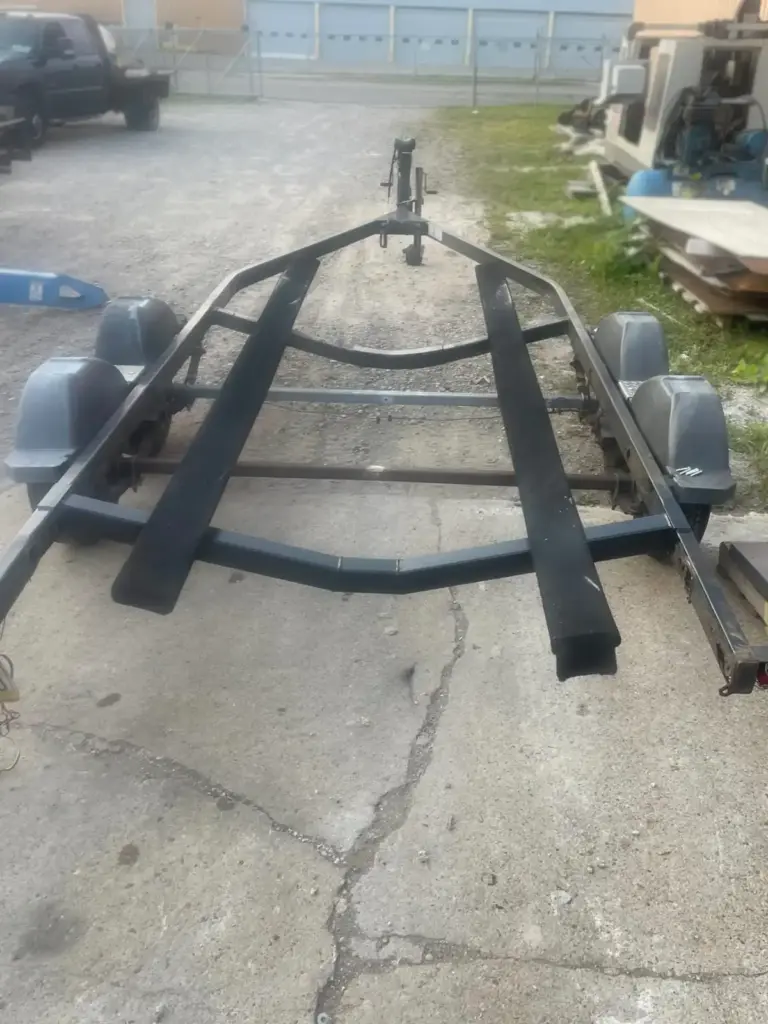
Cut out everything bad. Plasma cutter. The rusted rear rails, the broken crossmember, and every inch of tube that had lost wall thickness. You can’t weld onto rusted or thin steel and expect a sound joint. The metal has to be clean and full-thickness, or you’re just welding in a future failure.
Fabricated new rear rails. This is where our metal fabrication side comes in. New tube steel cut to match the original dimensions and wall thickness, welded into the surviving frame with full-penetration MIG at every joint. Heat dialed in for the material, proper preheat where it mattered. No cold starts, no skim welds. If I wouldn’t tow my own boat on it, we’re not putting it back under yours.
New crossmember. Cut, fit, welded, ground smooth, prepped for paint.
Bunks. New pressure-treated 2x6s, new marine-grade carpet, new brackets where the old ones were eaten up. Stainless hardware so we wouldn’t be back here again in three years.
Wiring from the hitch back. Marine-rated throughout. Sealed connections, heat-shrink on every splice, clean ground point welded to solid frame steel. New LED submersible tail lights that will actually still work after a boat ramp dunk.
Paint. Rust converter on any surface rust still there after grinding, then primer, then a heavy enamel topcoat. Galvanizing would have been better. Costs about double, and the customer had a number to stay under. Enamel done right gets you years before rust becomes a problem again.
Total time in the shop was about a week, working it in between other jobs. Could have pushed it faster if that was the only thing on the bench. Customer got his trailer back road-legal, the sale closed, and the new owner ended up with a trailer that’s structurally in better shape than a lot of 10-year-old units on the road.
Repair or Replace: How I Actually Decide
Every week, somebody drags a rough-looking trailer into our shop and asks me the same question. Fix it, or start over?
There’s no single answer. But there is a framework I use, and I’ll tell any customer the same thing.
When Repair Is the Right Call
Damage is in one area.
Rusted rear, cracked crossmember, shot tongue. If the problem is contained to a section I can cut out and replace without compromising the rest of the frame, repair is usually the play. The boat trailer above was a textbook example. Back third bad. Everything else fine.
Main frame is still true.
Tongue straight, main rails straight from the axles forward, no twist. That’s the spine. If the spine is good, there’s something to build on.
Axles and running gear are serviceable.
New axles change the math on a rebuild in a hurry. A trailer with solid running gear is usually worth saving. Related work like bent spindle repair falls in the same bucket.
Repair cost stays under roughly 60% of a new trailer.
Not a hard rule. A gut check. Below that, you’re getting real value. Above it, you should at least be thinking about whether a new one is smarter.
The trailer does something a stock replacement won’t.
Custom lengths, a dovetail, hydraulic tilt, a specific hitch setup built for a specific truck. If what you’ve got was built for a purpose and a replacement would have to be custom-ordered anyway, fix the one you have.
When You Should Buy New Instead
Rust is everywhere, not just in one spot.
If I’m tapping the frame with a hammer and finding soft steel in three or four different places, more is hiding. Cut all of it out and you’re essentially building a new trailer around an old tongue.
Main rails or tongue are bent, twisted, or cracked.
Different problem than rust. Structural damage to the load-bearing spine usually means the trailer was overloaded, wrecked, or both. Steel can be straightened. The fatigue from whatever bent it is still in the metal.
The trailer was overloaded or in an accident.
Impact damage and overload stress do things you can’t always see. Fatigue cracks show up months later. A trailer that’s been hit hard is a trailer you should be skeptical of, even if it looks fine now.
Repair cost is within shouting distance of a new trailer.
At that point, you’re paying the same money for an older axle, older suspension, and a frame that has already started aging out. If you’re in that spot, take a look at our trailer center — we build new trailers on-site too.
The Gray Area
Most trailers we look at fall somewhere between these two cases. That’s where honest inspection matters. I walk the whole trailer with the customer, point out what’s sound and what isn’t, and give a real range on what the repair would cost. Then they decide with actual numbers in hand, not a gut guess.
Common Trailer Frame Damage We See
Same categories of damage show up over and over, whether it’s a boat trailer, utility trailer, or equipment hauler.
Rust-through on rear frame ends.
The classic boat trailer killer. Water in, no way out, corrodes the tube from the inside. By the time it’s visible from outside, the wall is already compromised. Early warning signs: rust bleeding around welds or seams, soft spots when you tap the tube with a hammer. A solid tube rings. A rotted one thuds.
Cracked or broken crossmembers.
The crossmember under the transom on a boat trailer, or under the load point on a utility trailer, takes the most stress of anything on the frame. Cracks usually start at a weld, propagate outward, and eventually break through. Catch it as a crack and we can often weld and reinforce with our certified welding service. Catch it after it’s broken and it gets replaced.
Bent or twisted tongues.
Usually from a sharp impact, an overloaded tow, or jack-knifing at low speed. A tongue that’s out of true throws the whole towing geometry off. Sometimes we can straighten it. Sometimes it needs to be cut off and a new one fabricated.
Failed spring hangers and axle mounts.
Years of load cycles crack the welds where leaf springs attach to the frame. A hanger that lets go on the road is dangerous. We see this most on older utility trailers and landscape trailers that have been worked hard. Bent spindles from overloaded hubs are another common casualty — we cover that in detail in our post on bent trailer spindle repair.
Rotted or broken coupler mounts.
The front section where the hitch coupler attaches to the tongue can rust or crack. A coupler failure at highway speed is a worst-case scenario, and it’s one we’ve seen more than once.
Seized hinges on gates and ramps.
Not structural, but worth mentioning. Dump trailers, tilt trailers, and enclosed trailers with rear gates all have pivot points that freeze up from corrosion. Fixable, but often overlooked until the gate won’t open.
Structural cracks on heavy-duty trailers.
Equipment trailers and car haulers carrying heavy loads can develop cracks in the main rails or reinforcement points. That’s where our structural steel work comes in, because the repair requires proper process, proper filler metal, and proper load analysis.
If any of these sound like what’s going on with your trailer, the next step is to get it inspected. You can run through our trailer inspection checklist yourself to do a walk-around, or bring it in and we’ll look at it for free.
How Much Does Boat Trailer Frame Repair Cost?
Frame repair cost depends on how much steel comes out and how much goes back in. Every job is priced after inspection, not over the phone. Honest ranges, based on what we typically see at our shop:
- Localized patch repair (single rusted section, no structural cut): starting as low as $200-$400+
- Single crossmember replacement or coupler repair: starting around $350-$600+
- Rear frame section rebuild (like the boat trailer above): typically $800-$1,800+ depending on scope
- Full frame rebuild with bunks, wiring, and lights (essentially the complete back half of the trailer): $1,500-$2,500+
- Full structural rebuild on a larger trailer (tandem axle, heavier rail steel): can run higher depending on materials
For comparison, a new single-axle utility or boat trailer starts around $1,500-$2,500, a tandem-axle unit runs $3,500 and up, and a custom build can easily push past $5,000 depending on specs. When the repair math gets close to new-trailer money, we tell customers that. We’d rather see somebody in the right piece of equipment than take a job that doesn’t make sense for them.
Our free inspection is where these numbers get real. We look at the whole trailer, walk you through what’s sound and what isn’t, and write up an estimate you can actually use to decide.
Warning Signs to Catch Early
Most frame failures are preventable if you catch the damage before it gets serious. Walk around your trailer at the start of every season and look for:
- Rust bleeding out of seams, welds, or the underside of main rails
- Soft spots when you tap tube steel with a hammer
- Hairline cracks near welds, especially at crossmembers and spring hangers
- Rot in bunk wood (press it with a thumb; if it gives, replace it)
- Play or movement at the coupler, tongue weld, or spring hangers
- Any light that flickers or won’t ground properly, which often signals frame rust at the ground point
Our spring trailer inspection checklist covers the full walk-around if you want to go deeper. We also offer free in-shop inspections at our Flint location.
When to Bring It to a Shop
A lot of trailer work can be done in your own driveway. Replacing bunks, repacking bearings, swapping a tail light, tightening a U-bolt. If you have the tools and the time, there’s no reason to pay somebody else for it.
Frame work is a different story. Welding load-bearing structural steel isn’t a beginner project. A bad weld on a bunk bracket will loosen a bunk. A bad weld on a main frame rail can send your boat and trailer through a guardrail at 60 miles an hour. If any of the following applies, bring it to a qualified shop:
- The damage involves a main frame rail, crossmember, tongue, or spring hanger
- You’re not certified for structural steel welding (we hold AWS Level I and Level II certifications for structural steel and pipe)
- You don’t have the equipment to properly cut, prep, and weld tube steel
- The trailer carries more than its own weight (meaning anything that hauls a boat, equipment, or cargo)
Any structural trailer weld should be done by someone who knows what they’re doing, with the right process for the material, on clean prepped metal, with proper penetration. Anything less is a liability. If you’re in the Flint or Genesee County area and need a welder you can trust, that’s what we do every day. See our full certified welding services for more.
Free Trailer Frame Inspection
If you have a trailer you’re not sure about, bring it in.
We’ll do a free inspection, show you what’s sound and what isn’t, and give you honest numbers on what a repair would cost. No pressure, no sales pitch. If we think you’re better off with a new trailer, we’ll tell you that.
Iron Mann Industries
2110 Lapeer Road, Flint, MI 48503
Mon–Fri: 9:00 AM – 5:00 PM
Frequently Asked Questions
In most cases, yes. If the rust is localized to specific sections, like rear frame ends or crossmembers, a qualified welding shop can cut out the bad steel and fabricate new sections into the existing frame. Repair stops making sense when rust is widespread across the entire frame or when the main rails are compromised.
Our rule of thumb: if the repair cost stays under roughly 60% of replacement and the main frame is sound, repair is usually the better call. If repair gets close to the price of a new trailer, replacement usually makes more sense. An honest inspection from a qualified shop will give you real numbers to decide with.
Most localized frame repairs take 1-3 days in the shop. Rear section rebuilds like the boat trailer in this post typically run 4-7 working days, depending on how much fabrication is involved and what else is on the bench. Major structural rebuilds can run longer.
Yes, as long as the crack is in sound steel and the metal around it still has full wall thickness. We v-groove the crack, weld it with full penetration, and often add a reinforcement plate. If the steel around the crack is rusted or fatigued, it gets cut out and replaced instead of welded.
Costs range from $200-$400 for small patch repairs up to $2,500+ for full rear-section rebuilds including new bunks, wiring, and lights. The best way to get a real number is a free inspection at our Flint shop.
Iron Mann Industries is at 2110 Lapeer Road in Flint, Michigan. We serve customers throughout Genesee County and Mid-Michigan, including Flint, Burton, Grand Blanc, Davison, Fenton, Lapeer, Saginaw, and surrounding areas.
