
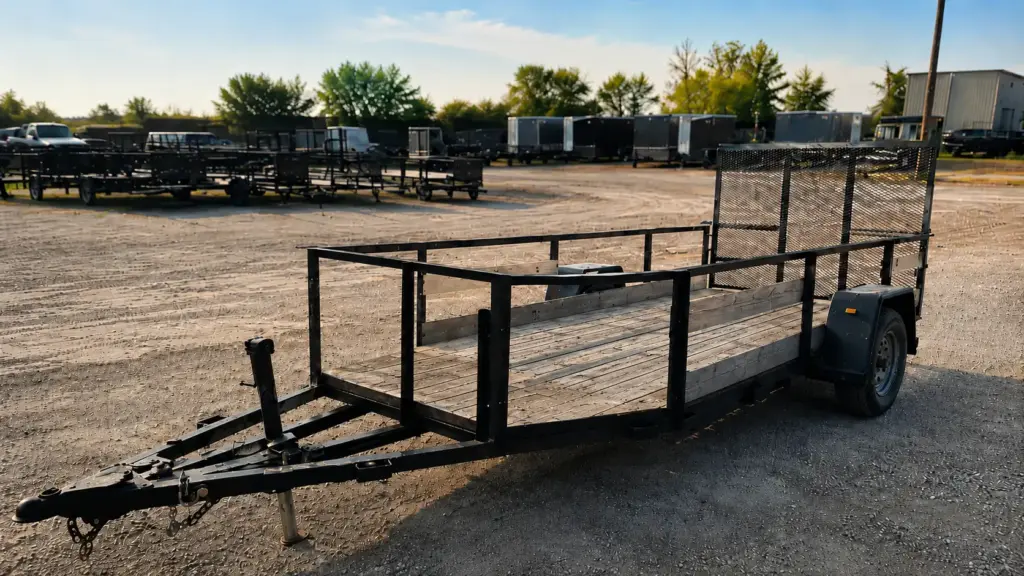
Just bought a used trailer in Michigan? Three things in order: get the title transferred and the registration in your name at the Michigan SOS within 15 days, walk the trailer for the 10-minute safety check (lights, chains, coupler, tires, bearings, brakes, frame), and get a professional inspection before your first heavy haul. IronMann Industries offers a free trailer safety inspection at our Flint shop for owners across Genesee County and Mid-Michigan. Here is the full action plan, in the order it actually needs to happen.
Buying a used trailer is one of those purchases where the excitement of getting it home is immediately followed by the question of what you actually just bought. Maybe it was a Craigslist deal in a guy’s backyard, an estate sale, an auction find, or a hand-off from a relative. Either way, you now own a piece of equipment that is going to carry weight at highway speed, and you have a short window to make sure it is legal, safe, and ready before you hook it up to anything that matters.
This is the sequence we walk every used-trailer buyer through when they show up at our shop in Flint with a “can you take a look at this” call. The order matters, because some of these steps are time-sensitive and the rest determine whether your first tow ends in your driveway or on the shoulder.
Step 1: Title Transfer and Registration (Do This Within 15 Days)
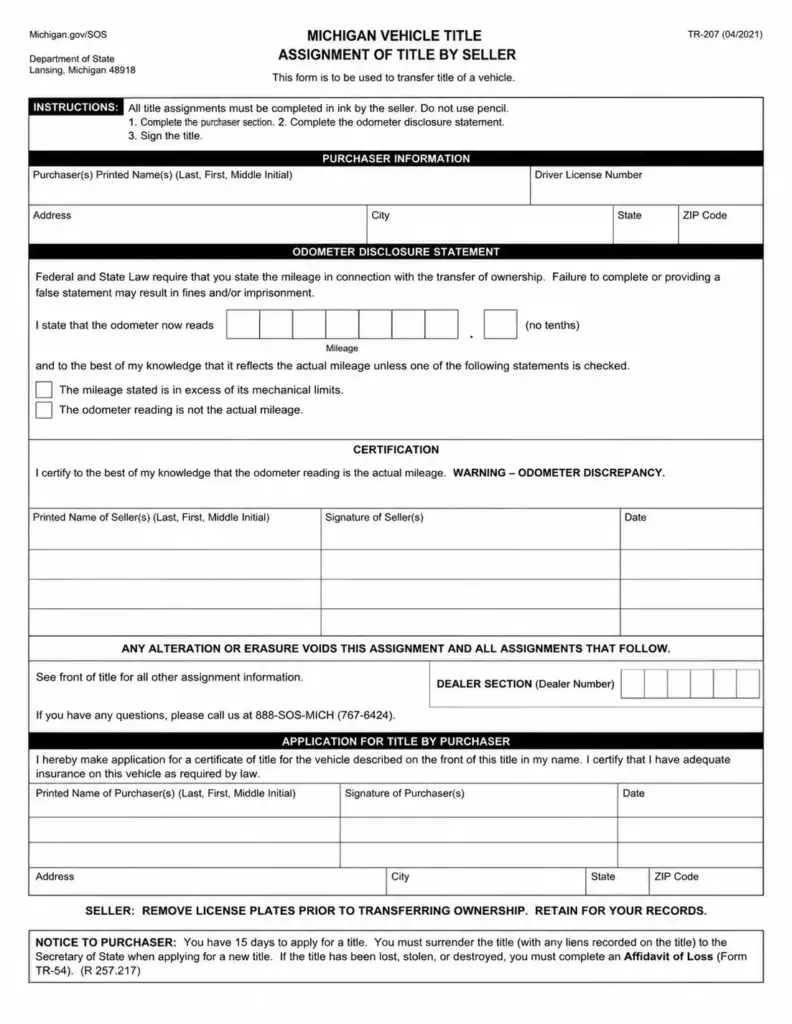
Michigan requires you to transfer the title and register the trailer within 15 days of purchase, and the clock starts the day the sale happened, not the day you got around to driving to the SOS. Miss the window and you are looking at late fees. Drive the trailer on public roads without it transferred and registered, and you are looking at a citation.
What you need to bring to the Michigan Secretary of State:
- The signed-over title from the previous owner (for trailers over 2,500 lbs gross weight)
- A bill of sale (for smaller trailers that do not require a title, this serves as proof of purchase)
- Your driver’s license
- Proof of Michigan no-fault insurance if the trailer is going to be insured separately
- Payment for title fee, plate fee, and use tax (calculated on the purchase price)
The SOS recreational vehicles page covers the trailer-specific edge cases (homemade trailers, abandoned trailers, no-title situations). If the seller could not produce a title and the trailer is over 2,500 lbs, do not just register it and hope. Sort the title situation first, because the SOS will eventually catch up with it.
One thing worth knowing: Michigan switched to permanent trailer registration for many trailer classes back in 2013. That means instead of paying every year, you pay a one-time fee (often $90) and the registration is good for the life of the trailer in your ownership. Check with the SOS clerk which class your trailer falls into. For most utility, cargo, and equipment trailers, this is the cheaper long-term path.
For the full picture on Michigan trailer registration, titling, and the rules that come with both, see our Michigan trailer laws guide.
Step 2: The 10-Minute Walkaround Before You Tow Anything
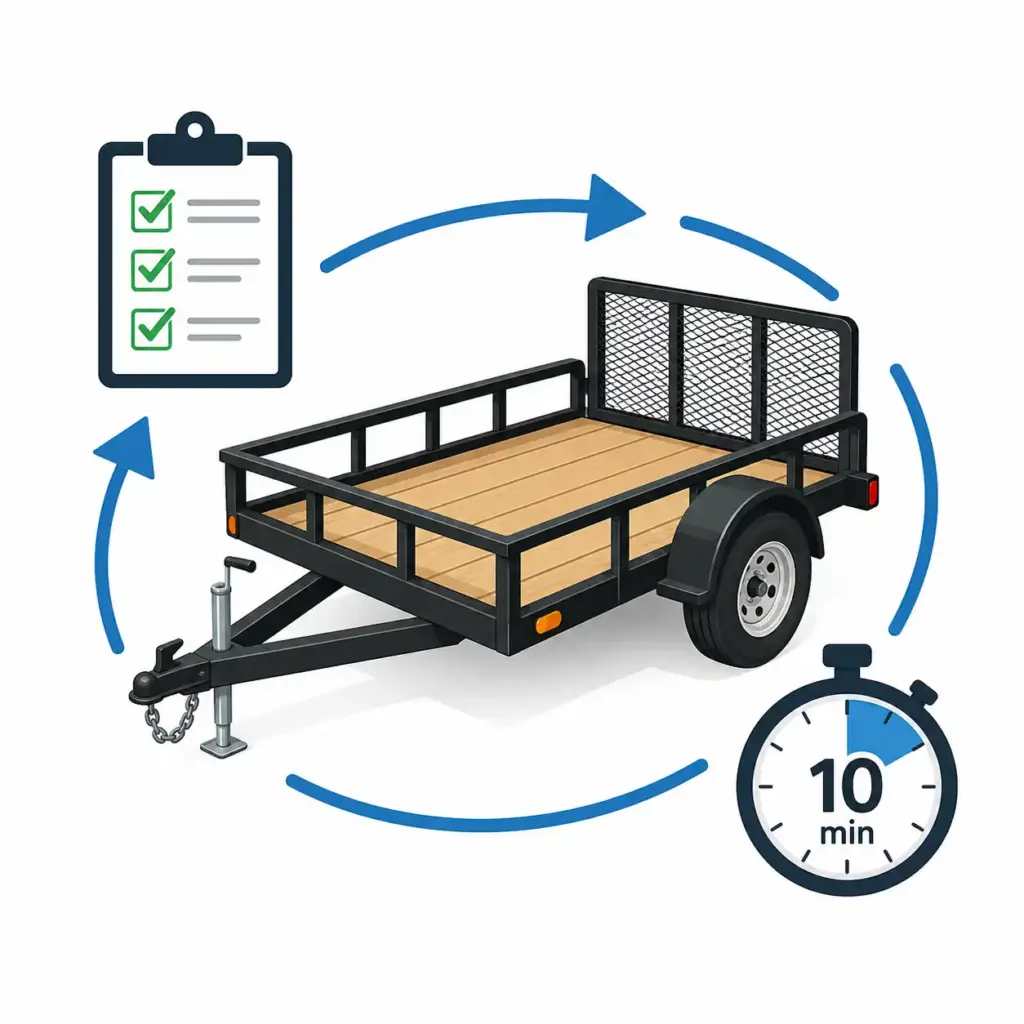
This is the walkaround we recommend before the trailer ever leaves your driveway loaded. It takes about ten minutes, and it catches roughly 80% of the problems that strand people on the highway.
- Coupler. Match it to your tow vehicle’s ball. A 2-inch ball in a 2-5/16 coupler tows fine until it does not, and the failure happens at the worst moment. The latch should lock fully with a pin or clip. Bent or worn latches need to be replaced.
- Safety chains. Two chains, crossed under the tongue, attached to frame-rated points on the tow vehicle. Not the bumper. Bumpers tear off. Check the hooks for wear and rust. Chains should be long enough to allow turning but short enough that they cannot drag on the pavement.
- Lights. Plug the trailer in to your tow vehicle and have someone walk behind the trailer while you cycle the brake, turn signals, and running lights. Every light should work, every time. A burned-out plate light is the most common reason troopers pull trailers over in Michigan.
- Tires. Check pressure (sidewall PSI, not the tow vehicle’s), tread depth, and sidewall condition. Trailer tires often look fine while having internal dry rot from sitting unused. If the tires are more than 6 years old (check the DOT date code on the sidewall), assume they are due for replacement.
- Wheel bearings. Spin each wheel by hand. Listen for grinding or roughness. Grab the tire at 12 and 6 o’clock and try to rock it. Significant play means the bearings need service.
- Brakes (if equipped). If the trailer has brakes (required by Michigan law over 3,000 lbs gross weight), test that they engage from your tow vehicle’s brake controller. No engagement means a wiring issue, a controller issue, or a brake issue. Any of the three need to be sorted before you tow heavy.
- Frame and welds. Walk the entire trailer looking at the frame, tongue, crossmembers, and welds. Hairline cracks, rust through, sagging crossmembers, and weld separations are red flags. Take photos of anything that looks suspect.
- License plate and light. Plate mounted on the rear, registration current, plate light working. This is the easiest thing to overlook and the most common citation.
For a printable version of this checklist you can run before every tow, our spring trailer inspection checklist covers the same walkaround in more depth.
Step 3: Decode the VIN and Confirm What You Have
Used trailers often come with verbal descriptions (“it’s a 5,000 pound trailer, I think”) that may or may not match what is actually stamped on the manufacturer’s plate. Before you load it heavy, find the plate (usually riveted or welded to the tongue or front frame) and confirm the real specs.
The key numbers to look for:
- GVWR (Gross Vehicle Weight Rating). The maximum the trailer is rated to carry, loaded plus trailer weight combined. Exceeding this is illegal and is the most common cause of structural failures we see in the shop.
- Empty weight. Subtract this from GVWR to get your real cargo capacity.
- Axle ratings. Stamped on the axle itself. Two 3,500 lb axles do not necessarily mean a 7,000 lb trailer, the frame, brakes, and tires all need to support that rating too.
- VIN. Use the NHTSA VIN decoder (free) to confirm year, make, and model. Helpful if the title says one thing and the trailer looks like something else, which happens with hand-me-down trailers more often than people realize.
If the plate is missing entirely (corroded, painted over, or never installed because the trailer is homemade), the trailer is not unworkable, but it does need to be evaluated on its components. Older or homemade trailers without plates often need a professional inspection to determine effective capacity, especially before loading heavy.
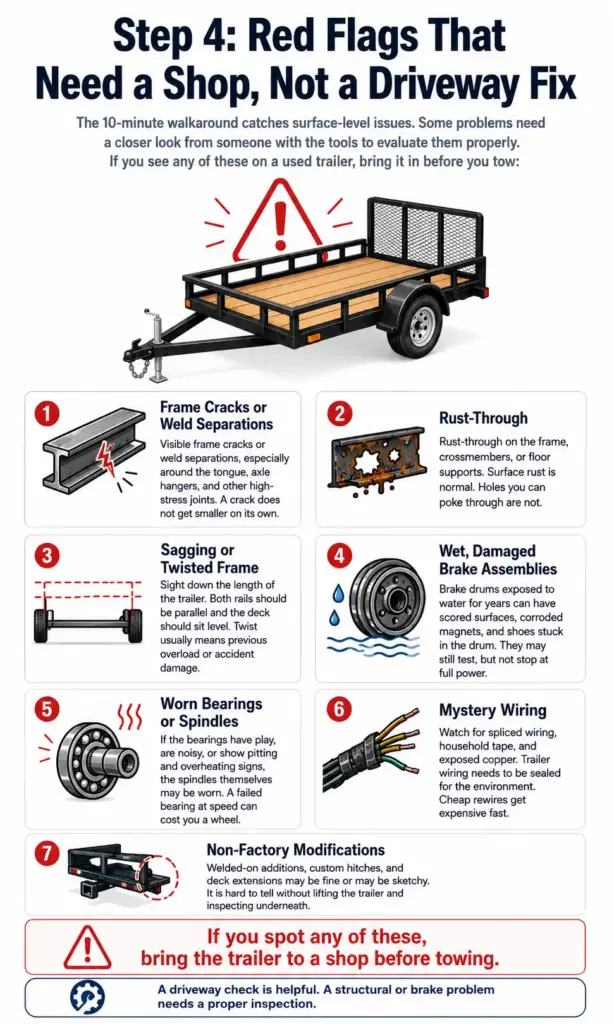
Step 4: Red Flags That Need a Shop, Not a Driveway Fix
The 10-minute walkaround catches surface-level issues. Some problems need a closer look from someone with the tools to evaluate them properly. If you see any of these on a used trailer, bring it in before you tow:
- Visible frame cracks or weld separations. Especially around the tongue, axle hangers, and high-stress joints. A crack does not get smaller on its own.
- Rust-through on the frame, crossmembers, or floor supports. Surface rust is normal. Holes you can poke through are not.
- Sagging or twisted frame. Sight down the length of the trailer. Both rails should be parallel and the deck should sit level. Twist usually means previous overload or accident damage.
- Brake assemblies that have been sitting wet. Drums that have been exposed to water for years often have scored surfaces, corroded magnets, and shoes that have grown into the drum. The brakes may still “work” on a controller test but have nowhere near their rated stopping power.
- Worn bearings that need more than a repack. If the bearings have play, are noisy, or show pitting and overheating signs, the spindles themselves may be worn. A failed bearing at speed is how people lose a wheel.
- Mystery wiring. Spliced-together wiring, household-grade tape, exposed copper. Trailer wiring needs to be sealed for the environment. Cheap rewires get expensive fast when lights start failing one by one.
- Modifications that do not look factory. Welded-on additions, custom hitches, deck extensions. Could be excellent work, could be sketchy. Hard to tell without lifting it up and looking underneath.
For specific common repairs, our posts on boat trailer frame repair and trailer spindle replacement show how we handle two of the most common used-trailer fixes.
Step 5: Get a Professional Inspection Before Your First Heavy Haul
This is the step most used-trailer buyers skip, and it is the one we recommend hardest. A used trailer has a hidden history. Maybe it sat in a barn for ten years. Maybe it hauled a payload that was always 500 lbs over rated. Maybe the previous owner repaired a frame crack with the wrong welder and never told anyone. You will not find that stuff in a driveway walkaround. Someone with a lift, a light, and the experience to know what they are looking at will.
That is what we built our free trailer safety inspection around. There is no charge, no obligation, and no high-pressure sales pitch waiting at the end. We check the brakes, lights, bearings, frame, coupler, and chains. If your trailer is solid, we tell you that and you are on your way. If there is something to fix, we tell you exactly what it is, what it costs, and whether it can wait. You decide what happens from there.
Customers come in for the free inspection from Flint, Lapeer, Fenton, Linden, Owosso, Holly, Davison, Swartz Creek, and Grand Blanc. Most leave with a confirmed-safe trailer and the confidence to hook it up to whatever they bought it for. The ones who needed work are glad we found it in the shop instead of on the highway.
Free Inspection on Your New-to-You Trailer
No charge, no obligation. We check everything that matters before your first haul. Serving Flint, Genesee County, and Mid-Michigan.
Schedule Your Inspection15 days from the date of purchase. Title transfer and registration both happen at the Michigan Secretary of State. Trailers over 2,500 lbs gross weight require a title; smaller trailers can typically be registered with a bill of sale.
For trailers over 2,500 lbs, do not register without sorting the title first. The Michigan SOS has procedures for missing-title situations including duplicate title applications and bonded titles for abandoned trailers. Visit the SOS recreational vehicles page for the specific process.
Michigan does not require an annual safety inspection, but towing a trailer with non-working lights, worn safety chains, failed brakes, or structural damage can result in citations and is dangerous. A 10-minute walkaround plus a professional inspection before the first heavy haul is the recommended baseline.
Look for visible cracks (especially around the tongue and axle hangers), rust-through, twist, or sagging. Sight down the length of the trailer; both rails should be parallel and the deck should sit level. Hairline cracks and rust-through both need professional evaluation before towing.
No. Title and registration work happens at the Michigan Secretary of State, not at our shop. We handle the inspection and repair side. The SOS is the authority on titling questions, including missing-title and homemade-trailer situations.
Brakes, lights, bearings, frame and welds, coupler, safety chains, tires, and the manufacturer’s plate. If your trailer is in good shape we tell you that. If something needs work, we tell you exactly what it is and what it costs. No obligation either way.
The first tow with a new-to-you trailer is when surprises tend to show up. Half of them are minor (a light that did not work, a tire pressure issue) and half of them are not (a brake that does not engage, a frame crack that opens under load). The point of the walkaround, the title work, and the inspection is to move those surprises out of the highway and into your driveway, where they are easy to deal with. That is the version of trailer ownership that lasts.
