
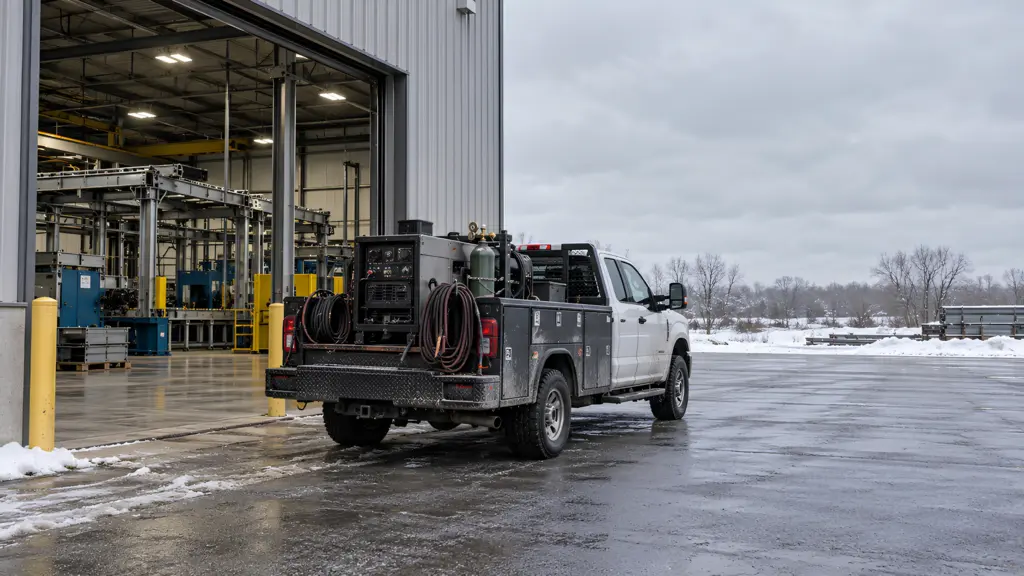
When should industrial welding happen on site instead of in a shop? Weld on site when the equipment is permanently installed, too heavy to rig out, or when pulling it stops production longer than the repair itself. Send it to the shop when field conditions cannot hold the required preheat, when machining follows the weld, or when TIG repeatability matters.
IronMann Industries runs a mobile welding unit and a shop at 2110 Lapeer Road in Flint, serving plants, municipal yards, and contractor fleets across Genesee County, Burton, Swartz Creek, Davison, Grand Blanc Township, Fenton, and Flushing.
Most mobile welding pages sell you a response time. Ours is going to do something different, because the response time is rarely the question that costs you money.
The question that costs money is whether the repair belongs in the field at all. We run both lanes, a truck and a shop, so we have no stake in talking you into either one. Here is how the call actually gets made.
Is It Faster to Pull the Equipment or Weld It in Place?
Short answer: Compare total hours the asset is out of service, not hours until a truck shows up. Sometimes the shop wins that comparison even with transport in both directions.
Here is the way this usually goes. A conveyor frame cracks at a weld near a drive end. The maintenance lead calls two shops. Both quote a mobile call, both promise to be out fast, and the decision gets made on who answers the phone first.
Nobody added up the hours. So add them up.
Field repair on that frame means the line is down while we grind out the old weld, set up, weld, let it cool, and inspect. Nobody runs product past an open arc and a hot repair. Pull-and-haul means teardown, rigging, a truck ride to Lapeer Road, the repair on a fixture where we can rotate the joint flat, a ride back, and reinstallation.
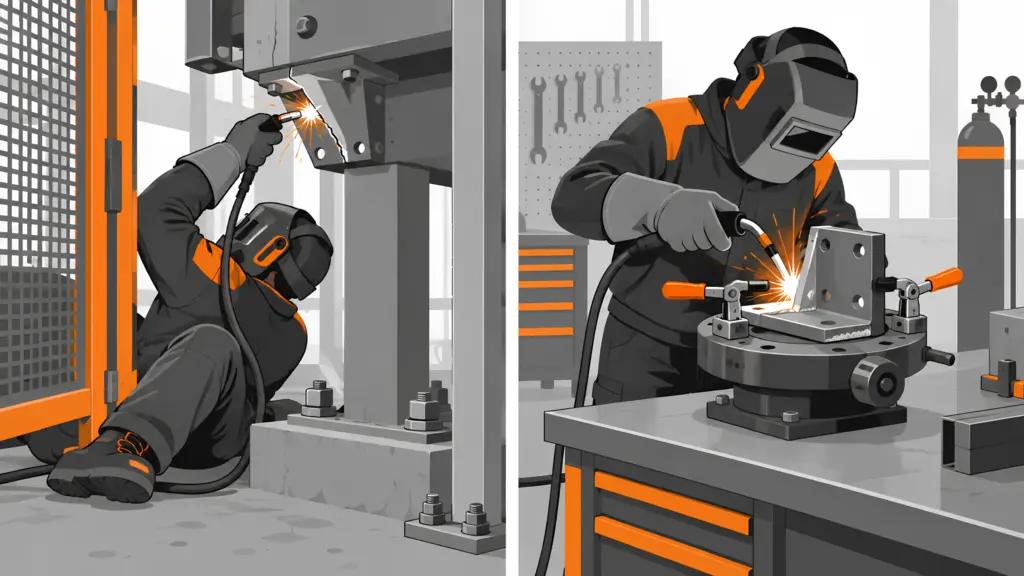
The field number is almost always smaller on paper. What gets left off the paper is the honest counterweight: a weld made overhead, in a tight space, on a surface nobody can rotate, is a harder weld than the same joint on a shop bench. If that repair cracks again on the next production run, you did not save time. You spent it twice and lost the production run in between.
That is the real trade. Field work buys you speed on this stop. Shop work buys you a better-controlled repair. Which one is correct depends entirely on the joint, and anyone who answers it before seeing the joint is guessing.
One local wrinkle works in your favor here. A breakdown in Flint, Burton, Swartz Creek, or Grand Blanc Township usually sits inside a half-hour drive of our shop. That keeps the shop option genuinely live. If you were two hours out, transport would settle the argument before anyone opened a hood. Around here it does not, which means the decision stays on the merits of the repair.
What Can Realistically Be Welded On Site, and What Needs Shop Conditions?
Short answer: On site is right for permanently installed structure and equipment that cannot be rigged out without pulling the line down. Shop is right whenever the repair needs machining afterward, tight temperature control, or a fixture that holds the joint in position.
We send the truck for work like this:
- Machine bases and mounts. Anchored equipment that cannot be unbolted without taking the whole line down.
- Conveyor framing and supports. Structure built into the building, not bolted to a skid.
- Handrail, guarding, and platform repair. Welded in place because it was built in place.
- Buckets, blades, and attachments on heavy equipment. Especially when the machine is parked where it broke.
- Cracked gussets and mounting plates on installed assets. Small repairs, big access problems.
And here is what we will tell you to bring to the shop, even though saying so costs us a mobile call:
- Anything needing machining after the weld. If a bore has to come back into alignment or a face has to come back flat, the part needs time on a mill or lathe. A field weld with no way to true it afterward is half a repair. Our CNC milling and turning lives at the shop, and it is not coming to you on a truck.
- Work requiring controlled preheat and interpass temperature. Heavier sections and certain base metals need the heat managed through the whole weld, not guessed at in a cold building.
- Repeatable TIG on thin aluminum or stainless. TIG wants clean metal, still air, and a position the welder can hold. Field conditions give you none of those reliably.
- Anything where position is the problem. If the joint can be rotated flat on a shop fixture and cannot be rotated at all where it sits, the shop weld is the one you can actually control, and that usually shows in the result. Position is not a detail, it is why welders get qualified position by position.
There is a third option most shops do not frame as an option, and it is the one that fits the best jobs we run: build it at the shop, install it in the field. We come out, measure the actual conditions, fabricate to those measurements in the shop where the conditions are controlled, then bring the finished work back and set it. That is how most structural steel fabrication jobs run, and it is exactly how an industrial catwalk or mezzanine goes into a running plant without shutting it down. Shop and mobile are not two services. They are one workflow with a decision point in the middle.
What Does a Mobile Welder Need From You Before the Truck Rolls?
Short answer: Truck access, a de-energized and locked-out machine, combustibles cleared, a clean weld area, and hot work authorization if the work sits outside a designated hot work area, plus a fire watch where the conditions call for one.
Say a plant maintenance supervisor calls about a cracked support under a packaging line. The repair itself is twenty minutes of arc time. The visit takes four hours, because the truck arrives and the machine is still energized, there is a drum of lubricant eight feet from the joint, and nobody has been assigned to stand fire watch.
None of that is anyone’s fault. It is just nobody’s job until somebody writes the list. So here is the list.
- Access for the truck and the leads. Welding leads have a working length. If we cannot park within reach of the joint, tell us on the phone so we can plan for it instead of discovering it in your lot.
- Power, or a clear statement that there is none. Tell us what power is available when you call. Knowing what we are working with changes how we set up.
- The machine de-energized and locked out under your program. We will exchange lockout procedures with you before the job, and our welder applies his own lock or tag to your group lockout before he strikes an arc. Nobody works under somebody else’s lock alone.
- The weld area cleaned. Hydraulic oil, grease, residual product, paint, and coating all have to come off before anything gets welded. Decide in advance whether your crew or ours is doing it, because it is real time either way.
- Ventilation, and confined space handled as confined space. If the joint is inside a tank, a pit, or anything with a permit requirement, that is a planned job with your procedures driving it, not a drop-in.
- Hot work authorization, and a fire watch if the conditions call for one. This is the one that catches people. Details in the next section.
Work through that before you call and the visit gets dramatically shorter. Most of it is five minutes of coordination that saves two hours of standing around.
Who Is Responsible for the Hot Work Permit and the Fire Watch?
Short answer: The facility authorizes it. Facility management authorizes hot work outside a designated area and designates who grants that authorization. Who stands the watch is a coordination item between your program and whoever supervises the welding, and OSHA puts duties on both: your program sets the requirement, and the welding supervisor on the job, including an outside contractor like us, has to secure the authorization and confirm the watch is actually in place before an arc is struck.
The mobile welding pages we reviewed for this piece did not mention permits or fire watch. That is strange, because on a plant floor it is the part most likely to stop the job.
Here is the shape of it. OSHA 1910.252 covers general requirements for welding, cutting, and brazing. It puts the responsibility for authorizing cutting or welding operations on the facility management, requires that combustible material be moved or shielded when the work cannot be relocated to a safe area, and requires fire watchers wherever more than a minor fire might develop, including where appreciable combustible material sits closer than 35 feet to the work, along with the other ignition conditions the standard lists. The watch has to be maintained for at least a half hour after the work finishes. Those are general industry rules. Construction welding and cutting falls under 1926.352, which sets fire precautions but carries no matching authorization or permit language.
NFPA 51B, the hot work standard many facility fire prevention programs and insurers are written against, sets a longer fire watch, at least one hour, with additional monitoring after that. Which one governs your building depends on your jurisdiction, your insurer, and your own written program. Your EHS contact knows. Ours does not, and we will not pretend otherwise.
Two practical points that come up constantly:
- OSHA says what the fire watch must be trained for and equipped with. The no-distracting-duties rule comes from fire codes and most written hot work programs, so check yours, but treat it as the working assumption: if you staff it as an afterthought, you have not staffed it.
- The watch continues after the arc stops. Metal holds heat and slag finds things. OSHA’s floor is at least a half hour after the work stops. Programs written to NFPA 51B run the watch at least an hour, with monitoring after that, so confirm your number instead of defaulting to thirty minutes.
We will work inside whatever your program requires, and we will say no to a field job where fire watch coverage is not available. That is not us being difficult. That is the one line in this trade where being accommodating is the wrong answer.
MIG, TIG, or Stick for an On-Site Structural Repair?
Short answer: The welder decides after seeing the joint, not on the phone, and inside whatever WPS or code requirement the job runs under. Outdoors and in drafty plants, stick and self-shielded flux-cored often beat gas-shielded MIG and TIG. AWS D1.1 holds gas-shielded processes to about 5 mph of wind at the joint unless you shelter it, and a loading dock door beats that easily.
Every competitor page in this category lists the same three processes and stops there. The list is not the useful part. The choice is.
MIG and TIG depend on a shielding gas blanket sitting over the molten weld pool. That blanket is fragile. Open a loading dock door, run a floor fan, weld outside on a breezy October afternoon in Flint, and the gas gets stripped away. What you get back is porosity, and it can sit under a cap that looks fine. Stick carries its shielding in the electrode coating, and self-shielded flux-cored wire generates its own shielding from the flux in the wire. Neither depends on a gas bottle, which is why they hold up where air is moving. Gas-shielded flux-cored is a different animal and belongs indoors with the MIG. That is the whole reason a “lesser” process routinely produces the better field weld.
Position matters just as much. A joint you can only reach overhead, with one hand, through a guard opening, is a different problem than the same joint lying flat. Base metal condition matters too: old steel that has been painted, oiled, and weathered through fifteen Michigan winters behaves differently from clean new stock.
So the honest answer to “which process” is that the welder picks it on arrival, after looking at the joint, the position, the metal, and the air, inside the WPS, engineering, and code requirements the job carries. Our mobile unit carries MIG, TIG, and stick capability for exactly that reason. Dennis Julian is an AWS Level I (structural) and Level II (pipe) certified welder, so the field call gets made by somebody who has to answer for the weld afterward. Our in-shop certified welding runs the same three processes.
How Does Emergency and After-Hours Response Actually Work?
We say emergency service available. We do not say 24/7, because 24/7 is a claim a shop our size cannot honestly guarantee, and you deserve to know which one you are getting.
When a line goes down and you call, the conversation runs roughly like this:
- What broke, and is anything unsafe right now. Safety risk gets triaged ahead of production impact, every time.
- Send photos before we load the truck. Wide shot for context, close shot of the failure, and something in frame for scale. Five minutes of photos tells us what to bring and sometimes tells us the part should come to us instead.
- Can you run at all in a degraded state. If yes, a scheduled repair during planned downtime usually beats a rushed one at 9pm.
- Stabilize tonight or fix properly once. Sometimes the right call is a field repair that gets you through the shift, followed by a proper shop repair during your next planned outage. We will tell you when that is what we think, and we will tell you plainly that the first repair is temporary.
That fourth one gets skipped by everybody selling emergency response, because a two-visit answer sounds worse than a one-visit answer. It often is not. A stabilizing weld that holds while you order the right material and schedule a window beats an overnight repair rushed to permanent that nobody is happy with.
What We See Most Often in Mid-Michigan Plants and Yards
The split follows a simple rule. If it unbolts, it rides in: buckets and attachments, hydraulic components, worn shafts, brackets and mounts that came off easily. If it is tied into the building, we drive out: machine bases bolted to the floor, conveyor framing, handrail and guarding, cracked gussets on equipment that cannot be moved without a crane.
Cold weather changes the picture. Field welding in a Michigan winter brings in problems the mobile welding pages written in Houston and Austin never consider. Cold steel pulls heat out of the weld faster, which changes cooling rate and preheat, and frost or condensation on the surface has to be dealt with before anything happens. In an unheated building or an open yard that is not a detail, it is the job.
One more pattern worth naming. When a part has failed twice in the same place, the weld is probably not the whole story. Repeat cracking at the same gusset points at something upstream, load path, material, or how it was repaired last time, and that is worth looking at before you weld it again. Welding it a third time is buying time, not fixing the cause. That is when we would rather fabricate a better version of the part than keep patching the original. It is also the logic behind most of our industrial machinery repair work: find the failure, then decide whether to repair it or build something that will not fail the same way.
What We Will Not Weld in the Field
Shorter list, but it matters more than the long one.
- Pressure-retaining or code-stamped work outside our scope. If it is pressure-retaining and needs certification we do not hold, an ASME-stamped new build or a National Board R-stamp repair, plus a qualified procedure, you need a different contractor, and we will say so on the phone instead of after the quote.
- Anything on a vessel or line that has not been purged and verified. No exceptions on our end, no “it’s probably empty.” Cleaning and verification before any arc is the rule we work to, out of 1910.252(a)(3) and AWS F4.1. Specialized in-service work run under its own procedures is somebody else’s scope, not ours.
- Semi trailers and interstate commercial equipment. Not our lane. Our trailer repair and custom build work covers utility, boat, equipment, and similar trailers.
- Jobs with no fire watch coverage available. Covered above. We will reschedule rather than work around it.
- Field repairs we think should be shop repairs. We will explain why, and if you still want it done in the field after hearing the reasoning, that is your call to make with full information.
Frequently Asked Questions
If the work happens outside a designated hot work area, OSHA requires the area to be inspected and the work authorized by a designated individual, preferably through a written permit. That rule sits in 1910.252 for general industry; construction falls under 1926.352, which sets fire precautions only. Programs written to NFPA 51B require the permit outright. Check with your EHS contact before scheduling. We cannot issue the authorization for you.
Sometimes, depending on the joint and the conditions. Thin or precision work in aluminum and stainless usually wants TIG, and TIG wants clean metal, still air, and a workable position. Thicker sections can run MIG. In a drafty building or outdoors, results get unpredictable. If the part can come to the shop, that is usually the better repair for those metals.
Tell us what power is available when you call. Knowing what we are working with changes how we set up. Whether there is facility power near the joint, where we can park, and how far the leads need to reach all change what we load on the truck and how long setup takes before we get to the weld.
We work across Genesee County and surrounding areas from our shop on Lapeer Road in Flint. Burton, Swartz Creek, Davison, Grand Blanc Township, Flushing, Fenton, and Linden are routine runs. Farther out, call and describe the job. We will give you a straight answer about whether it makes sense.
Yes, and we will tell you before you pay for a truck roll where possible. If the repair needs machining afterward, controlled preheat, or a position we cannot get in the field, the shop produces the better result. Running both lanes means we have no reason to steer you toward the wrong one.
Photos. A wide shot showing where the failure sits in the machine or structure, a close shot of the break itself, and something in frame for scale. If you know the material, say so. Five minutes of photos tells us what to load and occasionally tells us not to load anything.
Field work carries travel and setup time that shop work does not, so a given weld generally costs more in the field. The comparison that matters is total cost including your downtime and your own labor for teardown and reinstallation. Call with the details and we will quote both ways.
Usually we fabricate in the shop and install in the field, which gets you shop-quality work in field-measured dimensions. We come out, measure actual conditions, build to those numbers, then return and set it. That approach covers most platform, guarding, and structural work in operating facilities.
Talk to Us Before You Decide
Describe the failure and we will tell you whether it belongs in the field or on our floor. That conversation is free and it takes about five minutes.
Call us at (810) 407-7585 or reach out through the contact page. We are at 2110 Lapeer Road in Flint, Monday through Friday, 9:00 AM to 5:00 PM, with emergency service available outside those hours.
Not Sure If It Belongs in the Field or in the Shop?
Describe the failure, send a wide shot, a close shot of the break, and something in frame for scale. We will tell you whether the truck should come to you or the part should come to us. No charge for that call, no obligation. Serving plants, municipal yards, and contractor fleets across Flint, Burton, Swartz Creek, Davison, Grand Blanc Township, Fenton, and Flushing.
Send Us the Details